Draft v2 / 2026-07-30 / tell me what I missed
Catching the Misses
Survival Architecture in Living, Machine, and Human Systems
Philip Luu-Phuong Tran
Why I am writing this
I want to say plainly what I think is at stake, because an essay about unreported damage that stayed neutral about consequences would be doing the exact thing it warns against.
I am not writing this because the systems I live and work inside are bad. I am writing it because they are remarkable, and because they have a hole in them that is very hard to see from the inside. That is the difficult part. A system losing its ability to detect its own failures does not feel like decline while it is happening. It feels like quiet.
I think systems capable of extraordinary things are failing at this right now, and I think the failure is architectural rather than moral. Not because the people inside them got worse. Because their catching layers were absorbed by their deciding layers, because reporting became expensive to the reporter, and because the misses one part learns are hoarded instead of inherited. Every one of those is a design fault, which means every one of them is fixable. That is why I am writing this down instead of despairing about it.
I should be honest about what writing it down does. Every system in this essay was built after a disaster. The reporting programmes, the independent investigators, all of it arrived in the short window after something went badly wrong, when everyone agreed something had to change and nobody had a design ready. I do not expect an essay to open that window. I would like the design to be on the shelf when it opens.
And I think the clock is real. A system that cannot see its own misses is not stable, it is only slow. The damage does not stop when the reporting does. It accumulates, unpriced, until it arrives all at once as something that looks like a shock and was actually a decade of unread signals.
I want to start somewhere very small.
There is a rare inherited condition in which a child is born unable to feel pain. The nerves that carry damage signals never form. Parents describe the early years as a kind of vigil. The child bites through their tongue, chews their fingers, walks on a broken ankle for a week, sits in a hot bath without flinching. Most of the harm is not dramatic. It accumulates. Joints wear out because nothing tells the child to shift position. Small infections become large ones because nothing tells anyone to look.
The condition is not a failure of strength. These children are not weak. It is a failure of reporting. Everything else about the body works. The repair systems are intact, the immune response is intact, the capacity to act is intact. What is missing is the layer that says something is wrong, here, now, before the damage compounds.
Leprosy does the same thing later in life, and this is the part most people get wrong about leprosy. The bacterium does not dissolve fingers. It damages peripheral nerves, the patient stops feeling injury, and then ordinary life does the damage. A too-hot pan. A stone in a shoe. Diabetic neuropathy follows the same script and ends in the same place, which is why foot ulcers are one of the leading causes of amputation in the world.
In all three cases the organism is destroyed by things it could easily have survived, because it could not detect them in time.
I have spent the last several years building safety systems for machines that move through the physical world, and before that I taught mathematics and statistics. I came to this question from the engineering side. I have also spent many years in a sitting practice, which has nothing to say about autonomous vehicles and a great deal to say about noticing a state before you act on it. I do not know whether the two are connected. I notice that I keep building the same thing.
The more time I spend on this, the more convinced I am that what I am working on is not an engineering problem with a biological analogy attached. It is one architecture that nature arrived at independently many times, and that we keep failing to build deliberately into the systems we design ourselves.
This essay is an attempt to state that architecture plainly, in a form that applies to living systems, machine systems, and human collective systems without changing shape. I am calling it catching the misses.
Two layers, and only one of them decides
Put your hand on something hot. You withdraw it before you feel the pain.
That sequence is not a figure of speech. The withdrawal reflex is processed in the spinal cord. Sensory neurons carry the signal in, interneurons connect it, motor neurons drive the muscle, and the arm moves in a loop measured in tens of milliseconds. The signal continues up to the brain, and conscious pain arrives afterward. By the time you know your hand was on the stove, your hand is no longer on the stove.
You cannot think your way off a hot stove. So the body does not send that decision to the part of you that thinks.
The interesting design decision is not the speed. It is what the fast layer is not allowed to do.
The spinal reflex does not decide what you are doing in the kitchen. It has no view on dinner. It cannot form a plan, cannot weigh tradeoffs, cannot decide that the pan is worth the burn. It has exactly one function, which is to interrupt a trajectory that is about to produce damage, and then hand control back.
Nature builds two layers. A slow layer that decides direction, holds goals, weighs tradeoffs, and can be wrong in complicated ways. And a fast layer underneath it that holds no goals at all, cannot steer, and exists only to catch what the slow layer missed.
The separation runs both ways, and only one direction gets watched. A fast layer that starts making decisions is the failure everyone worries about. A slow layer reaching down into work the fast layer was already handling is the other one, and it is the one that ends careers in sport.
The slow layer is the one we admire. It is where intelligence lives. Almost all of our attention as designers, in machines and in organizations, goes into making it better. The fast layer gets treated as plumbing.
I think that is backwards, and I think the reason is that we consistently measure the wrong thing. We grade systems on the quality of their decisions. Nature grades them on the cost of their mistakes.
Why layering beats improving
Here is the argument that convinced me this is a real principle and not a pleasing metaphor.
When a cell copies DNA, the polymerase that reads the template and adds bases makes an error somewhere on the order of once in every ten thousand to hundred thousand bases. That is the enzyme trying its hardest. It is a highly optimized piece of machinery and that is roughly where its accuracy tops out.
The genome is billions of bases long. At that error rate, replication would be a catastrophe.
So there is a second layer. The same polymerase carries a proofreading function that reads back the base it just added and excises it if it does not pair correctly. That improves the error rate by roughly two orders of magnitude.
Then there is a third layer. Mismatch repair proteins come along afterward, scan the newly-made strand for distortions in the helix that indicate a mispair, cut out the region, and have it resynthesized. That improves the rate by another two or three orders of magnitude.
The result is an overall error rate in the neighborhood of one in a billion or better. Not because any single component is a billion-to-one accurate. Because three mediocre and independent checkers were composed.
This is the whole argument in one place. If your checkers are independent, their error rates multiply. Three layers that each catch ninety-nine percent of what reaches them produce a system that misses one in a million. You cannot get there by making one layer better. There is no enzyme that is a billion-to-one accurate, and evolution had four billion years to look for one.
The word that carries all the weight in that paragraph is independent. If the second checker fails in the same way and for the same reasons as the first, the error rates do not multiply, they barely move. Two checkers with correlated failures are approximately one checker. That single fact is the reason the rest of this essay has the shape it does, and it is the thing most often violated in the systems we build, because the cheapest way to build a second checker is to build it out of the same parts, by the same team, on the same assumptions, as the first.
The immune system, and the discipline of not steering
The immune system is the most complete implementation of this architecture that I know of.
There is an innate layer. It is fast, it is inherited rather than learned, it does not know what specific thing it is looking at, and it responds to broad signatures of the kind of molecule that should not be there. It is running before any recognition happens.
There is an adaptive layer. It is slow, it takes days, it learns the specific shape of a specific threat, and it is enormously more precise. It is also useless on its own during the first hours of an infection, which is exactly the window in which the innate layer keeps the organism alive.
And there is memory. Once the adaptive layer has learned a threat, the pattern is kept, and the next encounter is caught faster and earlier. The system does not just recover. It inherits its own corrections.
What I want to draw out is the constraint. The immune system never decides what the organism should do. It does not choose where to go, what to eat, who to live with, what to build. It has no access to those questions. Its entire authority is to detect that something is wrong and to trigger a bounded response.
And when that constraint fails, the result is autoimmune disease. A catching layer that starts making judgments about the body's own tissue does not improve the organism. It attacks it. The failure mode of a miss-catching layer that acquires the power to steer is not inefficiency. It is the system turning on itself.
This is worth sitting with, because the objection I hear most often when I describe this architecture is that it sounds like handing power to a technical elite. It is the opposite. The constraint is the design. The catching layer must be strong enough to interrupt and structurally unable to govern, and the moment you relax the second half you have built the disease rather than the defense.
Human systems have names for this authority, and the details are more instructive than the principle.
On a Toyota line, any worker can pull the andon cord. What most people believe happens next is wrong, and the mistake matters. The cord does not stop the plant. It lights a signal and calls the team leader, and the line keeps moving to the end of the work zone, which is a window of seconds. If the problem is resolved before the line reaches that point, nothing stops at all, and most pulls end that way.
That is the whole design. The act of raising your hand was made cheap, reversible, and routine, so the threshold for doing it is low. Make stopping a binary, expensive, once-a-year act and you will get a cord that nobody pulls and a factory that looks calm.
Aviation shows the same principle failing for the opposite reason. Any crew member can call a go-around, and the call is protected. Of approaches that are unstable and should be abandoned, around three percent actually are. The authority is real, the protection is real, and the call is not made in the great majority of cases where policy requires it, because the person making it has to be visibly wrong in front of the captain and there is no cheap version of the act.
So the catching layer's power is narrow in scope and does not have to be weak. It may halt within its target and it may not set direction. A worker who stops the line has not taken over the factory. But a catcher that cannot compel anything at all is a suggestion box, and there is a difference between the two that organisations are very willing to blur.
And if you want to know whether an organisation has a catching layer, do not ask what it monitors. Ask what it costs someone to raise their hand before they are sure, and what happened to the last three people who did.
The channel, and what it is allowed to carry
I described the reflex arc as having two layers. It has three parts, and I skipped the first one, which turns out to be the part that fails most often.
Sensory neuron in. Processing. Motor neuron out. Cut the sensory nerve and the spinal cord is intact, the muscle is intact, and the reflex is dead. The catching layer is not degraded. It is blind. This is why an organ that loses its innervation becomes invisible to the system that exists to protect it, and why the damage that follows looks identical to the damage from having no catching layer at all.
So the channel comes first. Build the catching layer before the channel and you have built an eye with no optic nerve.
Living systems put enormous machinery into this. A cell under stress does not wait to be inspected. It emits. Damaged and dying cells release molecules that recruit a response, so the first thing the system learns about an injury it learns from the injured tissue itself. Bacteria run quorum sensing, where no individual cell knows the population density and the shared chemical field carries information that no single member can hold. Vertebrates run a lymphatic network whose function is to carry samples from everywhere to a small number of places where they can be assessed, which means the system never needed all-to-all communication. It needed collection points. And the collection point is not the organ it is protecting.
Now the constraint, which I think is the most elegant thing in the whole architecture.
The immune system never opens the cell.
A cell displays short peptide fragments of what is inside it on its own surface, and a T cell inspects the fragment. Not the cell. The cell is never opened, never copied, never inventoried. What crosses the channel is the minimum signature sufficient to reach a decision, and nothing else.
The reason is not delicacy. Opening every cell to inspect its contents would kill the cell. A monitoring channel that has to damage what it monitors destroys the thing it was built to protect, and a system that loses its sources loses its sight. Non-intrusive sensing is a functional requirement. Biology did not arrive at data minimization because it was polite. It arrived at it because the intrusive version does not survive.
The failure modes of the channel are worth separating, because they look nothing alike from inside the system and they are constantly confused:
No channel. The catcher never fires. Everything is fine as far as anyone can tell, and the damage accumulates in silence.
Bad channel. The catcher fires on the wrong target. In immunology this is molecular mimicry, where a presented fragment resembles the body's own tissue closely enough that the response lands on healthy cells. Note what happened there. The catching layer worked exactly as designed. The signal was wrong. No improvement to the catcher fixes this.
Noisy channel. The catcher fires with nothing there. Allergy is a full immune response to something harmless. Sterile inflammation is a response with no pathogen at all. Cytokine storm is the signal amplifying itself until the response does more damage than whatever started it.
Which gives a statement I would put alongside the proofreading argument, because it has the same shape and is at least as consequential: the accuracy of a catching layer is bounded above by the fidelity of its channel. You cannot fix a signal problem with a better catcher. Almost all of the effort in the systems we build, in machines and in organizations, goes into the catcher.
The translations are immediate. A fleet of machines in which each unit's hazards stay inside the unit that encountered them has no channel, so every operator independently rediscovers the same rare situations forever. An organization in which the person closest to a problem has no path to anyone who could act on it has no channel, no matter how good its review process is. A review process fed by a filtered channel is a catcher fed molecular mimicry: it will fire, it will fire confidently, and it will fire at the wrong thing.
And the privacy constraint is not a concession made afterward to make the sensing acceptable. It is the condition under which the sensing keeps working. Carry the signature, not the source.
What counts as a miss
Every version of this argument runs into the same wall. I have stopped walking around it.
In the body there is nothing to argue about. The organism is trying to stay alive. Damage is damage whether or not anyone agrees it happened. The ground truth is physical, and no one has to be talked into it.
Then you move to the things we build, and especially the things we build out of people, and it looks like the ground goes soft. Who gets to say what a miss is? If the real answer is whoever holds the power, then the catching layer was never a catching layer. It is the deciding layer in a second coat, and the independence this whole essay rests on is already gone.
I do not think the ground goes soft. I think we stop being able to see it.
A miss is the moment the set of options still open to a system stops containing one that avoids the harm.
The last of the recoverable margin, spent. Not a gap between what happened and someone's idea of the good; that can never be made neutral, and I will not pretend it can. Something colder and simpler. Whether a way out was still there when it was needed. That is signed by physics, not by anyone's words. It asks no one to agree about what is good, only about which states are the end. And it finally catches the case that kept me up: the accident where every rule was followed and a person died anyway.
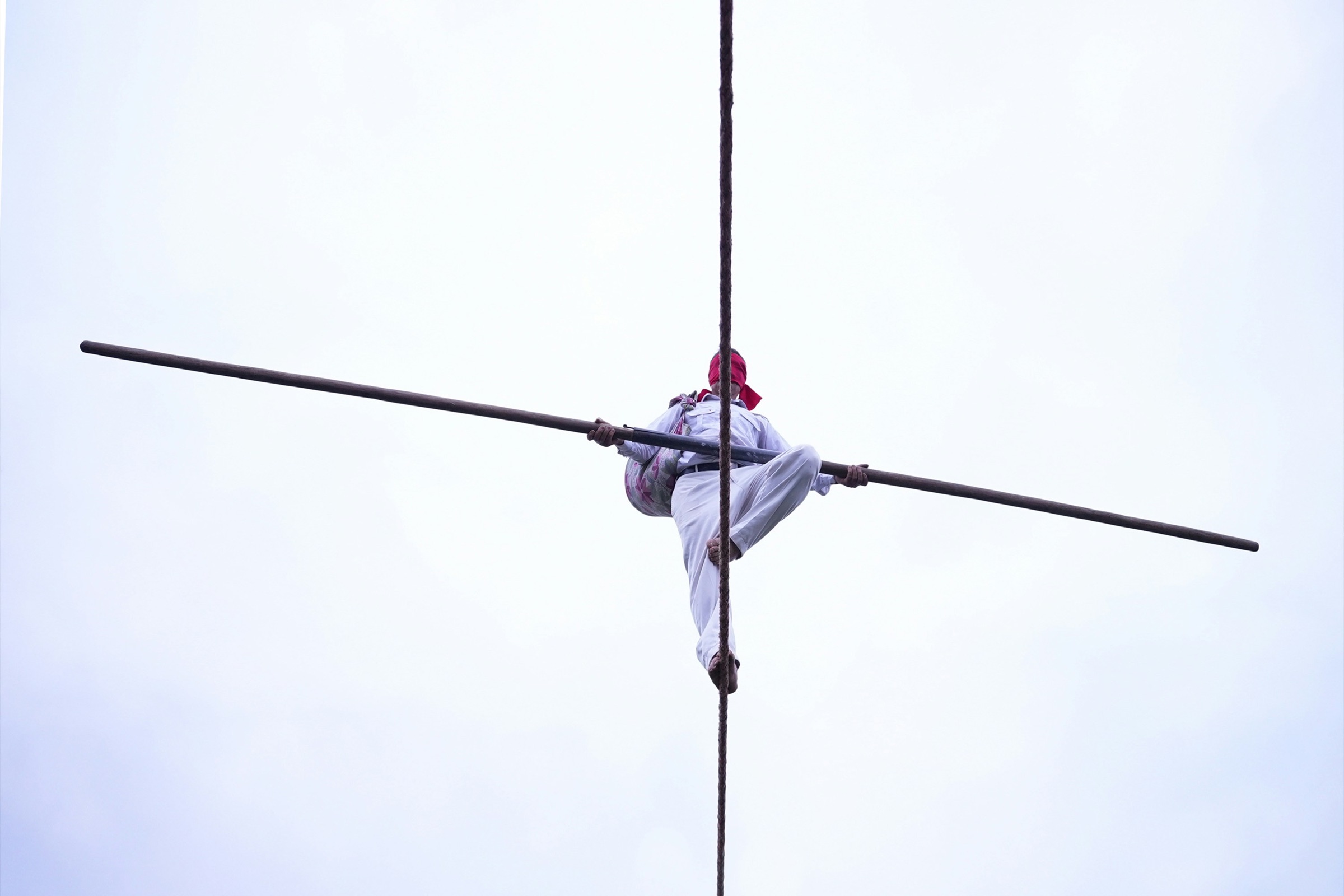
It is not a new thing. It is the oldest thing. It is what your hand does on the hot stove, pulling back before the pain, spending a little margin to keep the rest. It is what the cell does when it reads back the base it just laid down and cuts it out before it sets. It is what the walker does with the pole at the end of this essay, buying time for a correction to arrive. Margin is the pole. The miss is the instant the correction can no longer reach you. The biology was pointing at this sentence the whole time, and I was slow to look.
That is the definition. Now the hard part. You cannot always see the option set, and in anything made of people you almost never can. So you need a proxy. Something a person can measure on a Tuesday, that stands in for the margin when the margin cannot be read straight off the world.
The proxy is the gap between a declared expectation and an observed outcome. Between what a system said would happen and what did. It is not the definition, and I do not want it mistaken for one. It is the cheapest thing I can build that still tells the truth, and it earns its place by being something you can actually run. It gives a miss a shape you can hold. An expectation, stated in advance and on the record. An outcome, measured. The gap. The evidence. And someone with no stake in the answer to weigh it.
A car declares the road clear for the next two seconds and the world puts something in it. A plant declares an operating envelope and the process leaves it. A drug is approved on a stated safety profile and the watching afterward finds something outside it. Every time, the deciding party declared it first, and the proxy holds them to their own words. Which is why the declarations have to come first, and have to be kept. A system that declares nothing can never be caught missing, and a deciding layer under pressure feels the pull to declare less for exactly that reason. Vagueness is not modesty. It is the catching layer taken out quietly, so no one has to admit they took it.
The one who grades cannot be the one who decides. Same organ, both jobs, and the two checkers fail together, and their errors stop cancelling. And how far the proxy reaches has to be set from outside it. That is the hardest thing to build, and it is where this goes next.
Now the two ways the proxy lies, because a proxy that hid its own lies would be the very thing this essay is against.
It misses the harm no one declared. It catches the promise broken, and not the damage no one thought to declare against, which in most working lives is the larger share. No one wrote it down, so no one broke anything, and someone was hurt all the same. To the proxy, nothing happened. To the definition it is a miss like any other, because the option set closed no matter what anyone declared. A car that has no category for the thing in the road can call the road clear and be telling the truth, because clear means clear of what it can represent, and a person still dies. That is the whole distance between the proxy and the real thing. It is why I call it a floor and not the thing itself.
And the one being graded holds the pen. The party under measurement writes the declarations, so under pressure the true move and the paying move come apart: declare less, declare later, declare narrower, and the numbers climb while the thing rots underneath them. That is why the proxy is auditable and not neutral. Auditable only for as long as someone other than the declarer keeps the register, and no one can go back and change it. The definition is the check the proxy cannot give itself, because no one writes the margin. A system that has run out of it has run out of it, whatever it declared.
That answers something a sharp reader will catch, and should. Running the catching layer through the deciding layer's declarations makes the two share the same blind spots, and shared blind spots fail together, which the independence principle forbids. The way out is that the declarations are the proxy, not the floor. The floor is the margin, and no one writes it. Independence comes back where it has to.
What I do not have is a way to measure recoverable margin inside an organization the way I can inside a car. In a machine the option set is concrete: the states still reachable, the seconds to impact, the envelope you can still close. In a company it is just as real and I cannot yet put a number on it. So there the declared-expectation proxy is what runs, while I keep working on the harder thing. I would rather put the definition, the proxy, and the gap between them on the page together than hold this back until I can close it.
The report is not the punishment
Return to the child who cannot feel pain.
The catastrophic thing about that condition is not the absence of a repair mechanism. Repair works fine. It is the absence of a signal that repair is needed.
Now consider what happens to a system in which reporting damage is itself punished.
It does not become a system without damage. It becomes a system that cannot see its damage. Functionally, it acquires the neuropathy. Every incentive runs toward not noticing, not recording, and not saying. The damage continues at exactly the same rate and is now invisible, which means it compounds until it presents as a catastrophe rather than a signal.
Pain is a non-punitive report. It carries no judgment about who is at fault, it demands no confession, and it costs the reporter nothing to send. That is why it works.
Aviation is the only large human system I know of that built this deliberately and can show its work.
Aviation ran the experiment both ways, which is why its history is worth more than its results.
In December 1974, TWA 514 flew into a ridge near Mount Weather on approach to Dulles and killed everyone aboard. In the investigation it emerged that six weeks earlier a United crew had nearly repeated the identical clearance misunderstanding at the same place. That information existed. It had reached the crew's own airline. There was no route by which it could reach anyone else.
The first attempt at a fix was an FAA-run reporting programme, opened in 1975. It produced almost nothing, because pilots would not confess to the agency that held their certificates. In 1976 the same reports were routed to NASA instead, under an agreement between the two agencies, and the volume changed. Same pilots, same period, same reports, one variable moved. Nothing else in this essay is that clean an experiment.
What the reporter actually gets is narrower than the story usually told about it. Protection from enforcement is real but rationed: the sanction is waived, the violation is still found, the waiver is available roughly once in five years however many reports you file, the report must be filed within ten days, and it does not cover accidents, deliberate acts, or a demonstrated lack of qualification. It protects a certificate. It does not protect a job. And the reports are confidential rather than anonymous. Filers put their name on the form so an analyst can call back for detail; the identification strip is then detached and posted back to them, and that strip is the only proof they ever filed. That last piece of design is worth more than it looks, because it makes the reporter's protection something they hold in their own hand.
Two other parts of the system are usually described as the same idea and are not.
The National Transportation Safety Board was created in 1967 inside the Department of Transportation and was moved out by statute in 1975, precisely so the department housing the regulator was not also housing the investigator. Independence there was a remediation rather than a founding choice. Even now the Board is too small to do the engineering alone, so it designates manufacturers and operators, and the FAA itself, as parties to its own investigations. Independence at the board level, purchased expertise at the working level.
The Aviation Safety Action Program runs the opposite way from the reporting system and is instructive for it. Its review committee is tripartite: a company representative, a labour representative, and an FAA inspector, normally all three concurring. The enforcement authority is in the room by design, and eligibility is decided case by case with categories that lose protection entirely. That buys faster corrective action and costs some of the separation the national system has, which is why both exist rather than one.
Since 2007 the Aviation Safety Information Analysis and Sharing programme has pooled de-identified operational data across competing airlines, growing from four carriers to around forty-six. Its neutrality is not structural either. It is supplied by a contracted intermediary acting as trusted custodian, plus statutory non-disclosure protection.
Look at what none of that requires. It does not require the airlines to stop competing. It does not require anyone to be more virtuous than they are. It does not require agreement about anything except that the aircraft should not crash.
And it produced one of the great safety records in the history of engineering, in a domain where the failure mode is hundreds of people at a time.
It is not immune to the industry it sits under, and the last decade proved it. When certification authority for a new aircraft was delegated to the manufacturer's own employees, the reporting system was still there and still working. The thing worth reporting had simply been moved outside its scope. Two crashes and three hundred and forty-six people. That is not a reporting failure. It is a scope failure, and it is the sharpest available demonstration of why a catching layer's reach has to be set by someone other than the layer it catches.
This is the part I want people in my own field to sit with. Aviation did not get safe by having better pilots than everyone else. It got safe by building the layer that catches what good pilots miss, and by making it safe to report.
Two things I would not want a reader to take from that too easily.
The first is that formal protection is the smaller half. In most organisations, punishment for reporting is not disciplinary, it is social. Nobody is fired. You become the difficult one. You come off the good rotation, and the person whose work you flagged stops answering you. A policy that addresses the formal mechanism and leaves the social one untouched will produce a reporting system that looks healthy on paper and is empty. Anonymity and an external destination do more work here than any written assurance, which is a large part of why the reports go to NASA.
The second is that the loop has a return leg and it is the one that gets dropped. A person who files and hears nothing back files again, and then once more, and then stops. Not because they were punished. Because they concluded it went nowhere, and they were probably right. The cheapest way to kill a reporting culture is to receive everything and answer nothing.
Machines
Autonomous vehicles and autonomous machines are where I do my daily work, and the industry has a structural version of the problem I have been describing.
Enormous effort goes into the deciding layer. Perception, prediction, planning. It is genuinely impressive work and it is getting better quickly. The safety monitor, where one exists, is very often built by the same organization, trained on the same data, sharing the same representations, and reviewed by the same people who built the planner.
That is two checkers with correlated failures. By the proofreading argument, it is approximately one checker. The cases where the planner is confidently wrong are very often exactly the cases where a monitor built from the same assumptions is confidently wrong in the same direction, and those are the only cases that matter, because the ones where the planner is uncertain were never the dangerous ones.
Independence is where the multiplication comes from. All of it. A monitor that shares the planner's blind spots is not a second layer.
The second gap is at the fleet level. When a vehicle encounters something its stack did not handle, that event is one of the most valuable objects in the industry, and in almost every case it stays inside one company, treated as a liability to be managed rather than a signal to be propagated. Every operator is independently rediscovering the same rare situations. The immune system's central trick, which is that a threat encountered once is inherited as memory, has no equivalent at industry scale.
Aviation built a data exchange for this in 2007, under a legal environment at least as adversarial as this one, and it took fifteen years to grow from four carriers to forty-six. It is not an unsolved design problem. It is an unbuilt institution, and the build takes a decade and a half and a neutral custodian with legal protection.
One thing made that build possible which does not hold here, and it is worth saying plainly. No party surrendered authority it already had. The regulator gave up information it had never possessed, the pilots gained a protection they had not previously had, and nobody lost anything they were holding. Fleet operators today do hold their own data. That is why this exchange is harder than the one aviation built, and why the liability protection half of the design is not optional.
There is a second thing aviation had, and it was bigger than the first. The people deciding were in the aircraft. A captain who calls a bad approach and is wrong does not live to file the report, and neither do the passengers. That one fact did, quietly and for nothing, the whole job that protected reporting and independent review had to be built from scratch to do. The cost of the miss landed on the person making the call, in the same seat, at the same second. You do not have to engineer a conscience into a room where everyone is strapped to the outcome.
An autonomous fleet takes that away. The deciding layer sits on the ground now, in a building, and it does not go down with the car. The cost of the miss comes off the person who caused it and lands on a stranger on the road. So the protected channel, the independent catcher, and the inherited memory are not refinements on the aviation model. They are what you have to build to replace the one thing aviation got for free, because the cockpit supplied it by where it put the bodies. That is the deeper reason machines are the harder case. And it is why I only ever hand you aviation as half an argument. It is the easy case. The skin was already in the game, sitting in the seat.
I will say plainly that I have a commercial interest in this field, and that the architecture I am describing is one I am trying to build. That does not make the argument wrong, but the reader is entitled to know it, and the examples I have used here are deliberately all public ones from outside my own work.
Human systems
I am going to keep this section general, and I am doing that on purpose. The architecture is domain-independent, and the moment it is attached to a particular contest it stops being an architecture and becomes a position. Readers can apply it to whatever they are inside of. Every one of them is inside something.
The pattern that shows up in every organization I have worked in or built is the same. The deciding layer is well-resourced and the catching layer is understaffed, reports to the people it is supposed to be catching, and is the first thing cut when budgets tighten.
The specific failure modes translate directly:
Correlated checkers. The audit function that reports to the executive it audits. The review board staffed from the team whose work it reviews. Two checkers, one failure mode.
Starved checkers, which is the same failure wearing a respectable face. Independence written into a charter and not into a budget is independence on paper. Nobody has to overrule the office or abolish it. They decline to backfill it for three years and let attrition finish the job, and every document still says it is independent. If a catching layer's funding can be set by the layer it catches, it is not a second checker, whatever the org chart claims.
Punished reporting. The engineer who flags a problem and becomes the problem. The team that learns that raising a risk early is career-limiting and raising it late is survivable because by then it is everyone's problem. Nobody designs this. It emerges from ordinary incentives in about eighteen months unless something actively prevents it, and once it has emerged the organization has neuropathy and does not know it, because the absence of bad news is indistinguishable from good news from the inside.
Undeclared expectations. Goals stated vaguely enough that no outcome can falsify them. This is the most common defense against a catching layer and the hardest to name, because it looks like flexibility.
Monoculture. An organization in which everyone was trained the same way, hired for the same profile, and believes the same things about the domain has, by construction, correlated checkers all the way down. Ecosystems teach this at scale. Monocultures are efficient right up until the specific pathogen arrives that nothing in the field can resist, and then they fail completely rather than partially. Diversity in a catching layer is not a social preference. It is the independence requirement, wearing different clothes.
The thing I would emphasize is that none of these are moral failures and none of them are solved by better people. They are architectural. A system with correlated checkers and punished reporting will fail in these ways regardless of how good and how well-intentioned the people inside it are, and a system with independent checkers and protected reporting will catch things regardless of how ordinary the people are. Aviation is the proof. It is not staffed by saints.
I want to end this section with a picture, because I do not think the abstract version has earned enough.
Watch someone cross a high line. They carry a long pole, and the pole is heavy, and the first thing worth noticing is that it does nothing to move them forward. Not one inch of the distance comes from it. Its whole function is to make falling take longer, so a correction has time to arrive.
The second thing is that they are correcting constantly. The line is never still. Every step is a small recovery from a small failure, hundreds of them, and not one reaches the walker's attention. Ask what they were thinking about halfway across and they will tell you about the far platform. Not the ankle. Never the ankle.
The third thing is the one that matters. When the balance does reach their attention, they stop. You have seen this. The walker freezes, the pole swings hard, and everything that was going into forward motion goes into staying alive. They are not crossing now. They are fighting for permission to keep crossing. If it lasts long enough, the act is over whether or not they fall.
Now look at the pole again. It works because it has two ends and they pull against each other. A walker with nothing in their hands has nothing to correct with. The opposing weight is not the problem to be solved. It is the instrument. Take it away to make things simpler and they fall sooner.
I think a society is that walker. And I think we spend most of our time arguing about the pole.
What I want is not for the opposing forces to stop opposing. That is the pole, and a system without one is not calmer, it is only closer to the ground. What I want is for the correcting to happen below attention, where it belongs, so that the crossing continues while it happens. A system that has to convene, deliberate, and win an argument before it can notice it is falling has already stopped walking.
And nobody has ever gone out onto the line and learned to balance there. You go out because the balancing is already in you, already automatic, already beneath the level where you would have to choose it, and the entire reason it is there is so your attention is free for the far platform and for finishing the act.
But watch where they fail. It is almost never the middle. It is the last few steps, when the platform is close enough to want, and the balancing that was automatic the whole way surfaces into thinking. Now they are deciding what their ankles should do. Now they are arguing with themselves about something they knew perfectly well a minute ago. That is when the pole starts swinging.
So what does a trained walker do, given that the surfacing itself cannot be prevented?
Not what instinct offers, because instinct offers two things at that moment and both of them are the fall. Move fast and cover the remaining distance before the feeling gets worse. Or seize up and try to hold perfectly still, which on a line is not a stable state at all.
The trained answer is duller than either. Slow the breath down. Make the corrections smaller. Attempt nothing you have not already done a thousand times. Put your eyes back on the far anchor and leave them there.
That is worth stating plainly, because it is the part people get wrong under pressure. At high instability the size of your correction is the thing most likely to kill you. The pole works precisely by making the fall slow enough that a small correction is sufficient. So the discipline at the end is to reduce what you do rather than increase it, and to fall back on trained behaviour rather than improvise new technique while the stakes are highest.
A system has the same three options and the same correct answer. Under pressure the temptation is one large decisive input, something proportionate to how the moment feels. The feeling is real and the proportion is wrong. What holds is small corrections applied faster, attention on the far platform rather than on the wobble, and above all no dismantling of the mechanisms that were already doing the correcting. Those mechanisms are the trained behaviour. Overriding them because the moment feels too urgent for them is not decisiveness. It is the large input, arriving at the exact moment the line cannot absorb one.
Civilizations rise and fall like waves in an ocean. Each wave gets one crossing of the line. The ones before us made theirs and are gone, which is what waves do.
We are the wave on the line now, and I think we are in the last few steps.
That is what this is for. To hold the correcting underneath thought exactly when the stakes make it want to come up. So the last few steps are steps, and not a struggle to stand still.
The principles
Stated compactly, in three groups. The groups are the arc of the immune system and the arc of the aviation safety system. A system missing any one of them fails, and it fails differently in each case. This is meant to be usable as a checklist against anything.
Sensing. Can the system learn that something is wrong?
-
Signal From the Cell. Every part needs a path by which it can signal distress to the catching layer. A catcher with no channel is not degraded, it is blind, and the accuracy of a catcher is bounded above by the fidelity of its channel.
-
Carry the Signature, Not the Source. The channel transmits the minimum sufficient signature and nothing more. A channel that must open what it monitors damages what it monitors.
-
The Report Is Not the Punishment. If reporting damage is costly to the reporter, reports stop and damage continues unseen. This is the highest-return single change available to most systems and the one most often refused.
-
Declare First. A system that states no expectations cannot be caught missing. Vague goals are a way of removing the catching layer without appearing to.
Catching. Does something act on it, independently, without steering?
-
The Miss, Not the Enemy. The function of a catching layer is to detect and confirm failures of the deciding layer, not to replace it or defeat it.
-
Two Layers. A slow layer that sets direction and a fast layer that catches what it missed. The first may be partisan, interested, and goal-driven. The second may not be.
-
Independence Is the Multiplier. Checkers only compose if their failures are uncorrelated. Whoever certifies that a miss is real must have no stake in which answer it turns out to be, and independence written into a charter and not into a budget is independence on paper.
-
The Catcher Never Steers. Authority to interrupt and to trigger a bounded response. No authority to govern. The failure mode of violating this is autoimmune.
Learning. Does the correction propagate and compound?
-
The Confirmed Miss Is the Unit. Expectation, observation, gap, evidence, adjudication. Complaints are not data. Confirmed misses are.
-
Memory Propagates. A miss caught in one part of a system should become inherited protection for all of it. Hoarded misses are paid for repeatedly.
-
Grade Correction Cost, Not Decision Quality. The survival-relevant measure is time and cost to correct an error, not the apparent coherence of the decision that produced it.
-
Trust Compounds Both Ways. Each caught and corrected miss raises confidence in the layer, which raises reporting, which raises catches. Run in reverse, the same loop produces silence.
Two of these are in tension and I would rather name it than have it found. A minimum sufficient signature is deliberately lossy, and a confirmed miss needs enough evidence to adjudicate. How much can be stripped before the signature no longer supports a verdict is a real design question. Biology's answer is that the fragment is chosen to be diagnostic rather than complete, which is a per-domain answer and not a general one.
Who this is for
Put yourself four steps from the end.
You have been fine the whole way. Then something surfaces. The platform is right there, and your mind does what minds do, and it starts on the landing, the people waiting, the thing you will have done. In the same instant the balance you were not thinking about arrives in your attention. You look down. You see the wire. You see how close you came, and you understand you could go at any moment in the next four steps.
None of that is a failure of nerve. It is the design. The mind surfaces the automatic exactly when the stakes tell it to.
So what does a professional do about it? Not think harder. Thinking harder is the disease.
They keep their eyes on the far anchor, because attention on your own ankles is what kills you. They trust the soles of their feet, which report continuously, in great detail, and without waiting to be asked. They trust the inner ear, which knows they are tilting before they feel it. And they have rehearsed the wobble enough times that when it comes it arrives as information instead of as fear.
Every one of those exists in a society, and every one of them is somebody's job.
The far anchor is whoever holds the stated purpose and will not let it be renegotiated during the emergency. The soles of the feet are the people closest to the work, reporting what they actually see: the nurse, the technician, the operator, the pilot filing something nobody asked for. The inner ear is the independent measurer who can tell you that you are tilting while you still feel upright: the auditor, the inspector, the statistician inside an agency, the investigator with no stake in the verdict. The rehearsed wobble belongs to whoever runs the drill and writes the blameless post-mortem while it is still uncomfortable.
One place the anatomy misleads, and I would rather say it than let it stand. Proprioceptors do not know what their signal means. People do. The nurse usually knows exactly what the thing she is reporting means, often before anyone above her does, and an organisation that takes the observation and discards the interpretation has thrown away the more valuable half. The channel should be unemotional. The person on the end of it is not an instrument.
That is who this is for. Not the people who decide. The people who keep them upright.
If that is you, you have been running without a doctrine, without cover, and usually without any way to explain to your own organization why what you keep insisting on is not obstruction. Your function is the first one cut, because none of the forward motion appears to come from you.
None of it comes from the pole either. The crossing does not happen without it.
What this is for
I want to end by saying why I am working on this at all, because the architecture is the means and not the end.
The work that matters most to me is a hypothesis about people. I have spent years on the question of whether coherence between human beings is physically measurable, and whether its loss can be observed before the harm it precedes. The short version of the hypothesis is that connection between people has a signature, that loneliness is a chronic loss of that coupling, that crisis is preceded by measurable decoupling, and that the process by which groups of people stop recognizing each other as people is a decoupling as well. I hold all of that as an open research question rather than a result. Parts of it may be wrong. One of my own published findings on it was a null.
Here is the connection to everything above, and it took me a long time to see it.
I thought this essay was clearing the ground for that question. It is not. That question is already in here, as the first principle, one level up.
Signal From the Cell is the same object at three scales. Among cells it is molecular signaling. Across an industry it is a pooled exchange of what each operator learned the hard way. Between people it is coupling.
Which makes loneliness a severed afferent path. The person is intact. Every capacity is intact. What is missing is the route by which their distress reaches anything that could catch it. That is the same failure as the child who cannot feel pain, moved up one level, and it produces the same outcome for the same reason: ordinary damage, unreported, compounding until it presents as a catastrophe rather than as a signal.
And the second principle is the reason that sensing can be built at all without becoming the thing it is supposed to prevent. A capability that detects a person in distress, inside a system that punishes the report, is surveillance. Inside a system whose catching layer answers to its deciding layer, it is an instrument of that layer. Built the way a T cell works, reading a fragment, never opening the cell, carrying the minimum signature and nothing else, it is something else entirely. The question was never whether we can sense. It is whether we can sense the way living systems learned to.
So the architecture is not a preface to the work I care about. It contains it.
There is a debt in this that I want to name. Long before anyone had instruments, people left everything behind to look for this signal inside themselves, and reported back carefully about what they found. They did that for centuries, with no way to measure any of it, and largely on behalf of people they would never meet.
I would like to take those reports seriously enough to test them properly. Not to confirm them. Testing something honestly is the respect it was actually owed, and it is the only kind I am in a position to offer. If the instruments say no, that is an answer they earned too.
And underneath all of it there is one primitive, and it is the same one every time. Catch the dangerous state in the moment before harm. A collision. A crisis. A fracture. The systems differ, the timescales differ by ten orders of magnitude, and the shape does not change.
Nature built this many times without being told to. We should be able to build it once on purpose.
If you find a miss in this, I would like to hear it, particularly in the definition of a miss under "What counts as a miss" above. That definition has already been attacked and it did not survive intact. What the reviews found is on the declared page, and the objections are on the docket, anchored to the sentences they attack.